Saturday, August 29, 2026
JyotishShastra
Hindu Dharma - Official Portal
No Result
View All Result
  • Login
  • Register
  • Hinduism
    • Hindu Dharma
    • Hindu Tenets
    • Hindu Worship
      • Puja
      • Vrat Katha
    • God-Goddess
      • Deities
        • Vishnu
        • Bramha
        • Mahesh
      • Other Deities
    • Hindu Ethics
    • Hindu Scriptures
    • Rishi ! Acharya | Philosophers
    • Puja/Jaap/Hawan
    • Hindu Samskara
    • Hindu Philosophy
      • Hinduism
      • Arya Samaj
      • Jainism
      • Buddhism
    • Customs Traditions
  • Festival
    • Know Festival
    • Festival Cousins
    • Music
    • Prayers
      • Aarti
      • Bhajan
      • Kiratan
  • Spirituality
    • Kundali Yoga
    • Chanting
    • Healing
  • Temples
    • Tirth
    • Ashrams/Math
    • North India
    • South India
  • Yoga Tradition
    • Meditation
    • Pranayama
  • Vedic Science
    • Science & Beliefs
    • Vedic Architecture (Vastu)
    • Vedic Astrology
  • Health Remedies
    • Natural Remedies
    • Ayurveda
    • Health Tips
  • Hindu Facts
    • Hindu Dictionary
    • Symbolism
    • Quotations
    • Self Help
    • Sacred Rivers
    • Sacred Plants
    • Sacred Animals
    • Articles
    • Audios
    • Videos
    • Books
    • School of Thoughts
    • References
No Result
View All Result
  • Hinduism
    • Hindu Dharma
    • Hindu Tenets
    • Hindu Worship
      • Puja
      • Vrat Katha
    • God-Goddess
      • Deities
        • Vishnu
        • Bramha
        • Mahesh
      • Other Deities
    • Hindu Ethics
    • Hindu Scriptures
    • Rishi ! Acharya | Philosophers
    • Puja/Jaap/Hawan
    • Hindu Samskara
    • Hindu Philosophy
      • Hinduism
      • Arya Samaj
      • Jainism
      • Buddhism
    • Customs Traditions
  • Festival
    • Know Festival
    • Festival Cousins
    • Music
    • Prayers
      • Aarti
      • Bhajan
      • Kiratan
  • Spirituality
    • Kundali Yoga
    • Chanting
    • Healing
  • Temples
    • Tirth
    • Ashrams/Math
    • North India
    • South India
  • Yoga Tradition
    • Meditation
    • Pranayama
  • Vedic Science
    • Science & Beliefs
    • Vedic Architecture (Vastu)
    • Vedic Astrology
  • Health Remedies
    • Natural Remedies
    • Ayurveda
    • Health Tips
  • Hindu Facts
    • Hindu Dictionary
    • Symbolism
    • Quotations
    • Self Help
    • Sacred Rivers
    • Sacred Plants
    • Sacred Animals
    • Articles
    • Audios
    • Videos
    • Books
    • School of Thoughts
    • References
Hindu Dharma - Official Website
Home Hinduism God-Goddess Deities Vishnu

Greatness of Chapter Seven of Bhagwat Gita

Greatness of Chapter Seven of Bhagwat Gita
3
VIEWS
Share on FacebookShare on Twitter

Here
below is explained the Greatness of 
Chapter Seven of Bhagwat Gita. Read the story below to see, how all
the sinful reactions are destroyed by just reading the Chapter 7 of the Bhagwat
Gita.


“In the olden times, there was a brahmin by the name of Shanku-karna, who was occupied as a businessman. Shanku-karna amassed so much wealth that even kings visited his house to dine. But the miserly Shanku-karna kept some of his wealth buried, concealed from his relatives, and he never performed devotional acts or the rituals for his forefathers. Once, after his fourth marriage, Shanku-karna took rest for the night. While asleep, he received a snakebite and died. Later he attained the body of a snake-ghost, and he came to reside at the place where he had buried his wealth. Eventually he became tired of being trapped in a ghostly body, so he appeared to his sons in a dream and asked their help.


When his lazy sons woke up, they talked about their dream. Then one of them took a spade and went to the place his father had indicated. The son did not know exactly where to find the buried wealth, but he searched greedily until he found a snake hole. As he started to dig, suddenly a huge and appalling snake crawled out and asked, “Who are you? Who sent you to dig here?” Trembling for his life, the son replied: “It is me, your son, Shiva, to whom you appeared in a dream.”


The snake laughed and asked, why you indeed as his son, had not performed the necessary rituals to free him from the hellish life. The son inquired how to do this. His father replied, “Not by any kind of charity or austerity but only by recitation from the seventh chapter of the Bhagwat Gita will I become free from birth and death.” The father instructed his son to invite a brahmin to recite the seventh chapter during a ceremony to offer oblations to the forefathers. As this ceremony took place, the brahmin chanted the seventh chapter of the Bhagwat Gita, and Shanku-karna gave up his frightful body and attained a divine four-armed form. Before he left for Vaikunth Dham he blessed his sons and told them the location of his wealth.


After digging it up, the sons, whose minds had become fixed in devotion to Lord Krishna, used the wealth to build temples, dig wells and holy ponds, and distribute sanctified food. Moreover, the sons daily recited the seventh chapter of the Bhagwat Gita and quickly attained the devotion of Lord Krishna. Anyone who recites or hears this chapter will be freed from all the sinful reactions.

So that is the greatness of Seventh chapter of Bhagwat Gita.”

Chapter Seven of Bhagwat Gita is entitled “The Yoga of Jnana (Knowledge of Nirguna Brahma) and Vijnana (Knowledge of Manifest Divinity).”

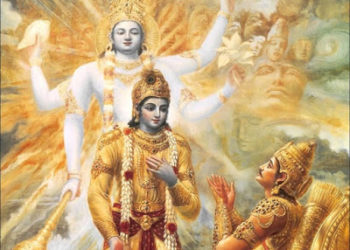
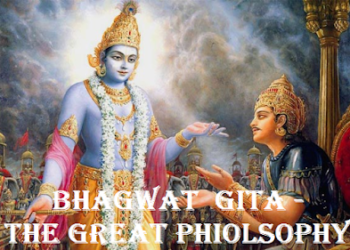
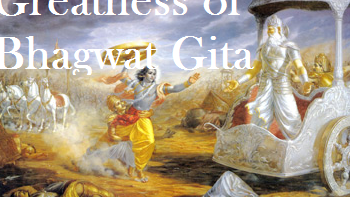
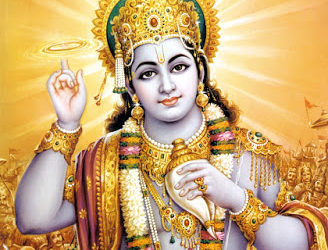
On the battle field of Kurukshetra, when Arjuna, the disciple of Lord Krishna got infatuated & forgot his duty to fight, then Lord Krishna reminded Arjuna of his duty to fight a lawful, justful war & gave him the teachings of Bhagwat Gita. Arjuna after having been taught in the path of knowledge by Lord Krishna came back to his path of duty & fought a lawful battle against the Kauravas (his enemies) & won the battle with the grace of Lord Krishna.

Bhagwat Gita: Chapter Seven (7) is entitled “The Yoga of Jnana (Knowledge of Nirguna Brahma) and Vijnana (Knowledge of Manifest Divinity).” This Chapter has a total of 30 verses.

Verses 1 to 7 describes the Wisdom with real Knowledge of Manifest Divinity.

Verses 8 to 12 describes about the Inherence of God in all objects as their Cause.


Verses 13 to 19 are about the Condemnation of men of demonical nature and Praise of devotees.

Verses 20 to 23 are about answering the question of worship of other gods.


Verses 24 to 30 are about the Condemnation of men, who are ignorant of the glory and true nature of God, and approbation of those who know them.

To read complete chapter Seven (7) Verse by Verse in Original Sanskrit Language Text & its English Translation……Click here to read………..Bhagwat Gita: Chapter Seven (Chapter-7)

Below are some verses from Seventh chapter of Bhagwat Gita:

“udarah sarva evaite
jnani tv atmaiva me matam
asthitah sa hi yuktatma
mam evanuttamam gatim” (Bhagwat Gita: Chapter Seven verse 18)


“Sri Krishna said: All these devotees are undoubtedly magnanimous souls, but he who is situated in knowledge of Me I consider to be just like My own self. Being engaged in My transcendental service, he is sure to attain Me, the highest and most perfect goal.”


“bahunam janmanam ante
jnanavan mam prapadyate
vasudevah sarvam iti
sa mahatma su-durlabhah” (Bhagwat Gita: Chapter Seven verse 19)

“Sri Krishna said: After many births and deaths, he who is actually in knowledge surrenders unto Me, knowing Me to be the cause of all causes and all that is. Such a great soul is very rare.”

“antavat tu phalam tesam
tad bhavaty alpa-medhasam
devan deva-yajo yanti
mad-bhakta yanti mam api” (Bhagwat Gita: Chapter Seven verse 23)

“Sri Krishna said: Men of small intelligence worship the demigods, and their fruits are limited and temporary. Those who worship the demigods go to the planets of the demigods, but My devotees ultimately reach My supreme planet.”

“vedaham samatitani
vartamanani charjuna
bhavisyani cha bhutani
mam tu veda na kaschana” (Bhagwat Gita: Chapter Seven verse 26)


“Sri Krishna said: O Arjuna, as the Lord of the universe, I know everything that has happened in the past, all that is happening in the present, and all things that are yet to come. I also know all living entities; but Me no one knows.”

“jara-marana-mokshaya
mam asritya yatanti ye
te brahma tad viduh krtsnam
adhyatmam karma chakhilam” (Bhagwat Gita: Chapter Seven verse 29)

“Sri Krishna said: Intelligent human beings who are endeavoring for liberation from old age and death take refuge in Me in devotional service. They are actually Brahman because they entirely know everything about transcendental activities.”

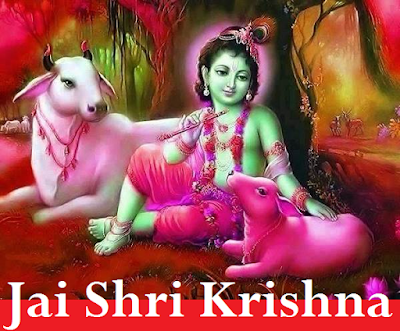
Jai Shri Krishna
Source link

Like this:

Like Loading…
Previous Post

Bhogolik Ghatna 20 March Equinox 2020; (Equal Day and Night); All You Need To Know In Hindi About March Equinox 2020 | इस बार 21 नहीं 20 मार्च को ही दिन और रात हुए बराबर

Next Post

Secrets of Yogmaya temple of Krishna era- Delhi, India

Related Posts

Who Illumines & makes this Body of ours Work?
Vishnu

Who Illumines & makes this Body of ours Work?

27/03/2020
Immortality of Soul as per Bhagwat Gita
Vishnu

Immortality of Soul as per Bhagwat Gita

26/03/2020
How Bhagwat Gita can transform Your Life?
Vishnu

How Bhagwat Gita can transform Your Life?

25/03/2020
Vishnu

A Blog about Philosophical views of the Author

24/03/2020
Greatness of Chapter Five of Bhagwat Gita
Vishnu

Greatness of Chapter Five of Bhagwat Gita

23/03/2020
Greatness of Chapter Six of Bhagwat Gita
Vishnu

Greatness of Chapter Six of Bhagwat Gita

22/03/2020
Next Post

Secrets of Yogmaya temple of Krishna era- Delhi, India

Discussion about this post

जुड़ें और शेयर करें

Are you interested in Hinduism, professional, educationist, scholar, blogger, or a religious services provider?

Join the hindu largest community portal to contribute n share news, information, blog, knowledge etc..

|| वसुधैव कुटुम्बकम् ||
॥ (महोपनिषद्, अध्याय ४, श्‍लोक ७१) ॥

Categories

  • Aarti
  • Bhajan
  • Customs Traditions
  • Hindu Dharma
  • Hindu Ethics
  • Hindu Philosophy
  • Hindu Worship
  • Hinduism
  • Hinduism
  • Jyotish Shastra
  • Mantra/Jaap
  • Meditation
  • NavGrah Planets
  • Puja
  • Puja/Jaap/Hawan
  • Spirituality
  • Temples
  • Tirth
  • Vishnu
  • Vrat Katha
  • Yoga Tradition

Recent Posts

  • मंगल दोष क्या होता है ? मंगल दोष कैसे दूर करे
  • नारायण बलि पूजा क्यों करनी चाहिए ?
  • Jaya Durga Lakshmi Saraswati – Durga Parameshwari by Vikram Hazra – Art of Living Bhajan
  • Positive and Negative Effects of Saturn in 12 Houses

Subscribe to Email

Subscribe to our monthly newsletters.

Hindu Temple Shrine Board
Shri Amarnath Ji | Shri Badarinath Kedarnath | Mata Vaishno Devi | Shri Banke Bihari | Mathura – Vrindavan | Tirupati Devasthanams | Shri Saibaba Shirdi | Shree Rameswaram | Shree Jagannath | Shree Dwarkadhish | Shri Kashi Vishwanath | Maa Kamakhya Devalaya | Shree Mahakaleshwar | Sree Guruvayur Devaswom | Shree Siddhivinayak

Disclaimer: HinduDharma.in website doesn’t represent or related to any Hindu religious board, radical organization, personality & so forth. This religious ideation is just crafted to share and promote facts, information, and teachings of Hindu culture for spreading Sanatana wisdom, practices for better-living n joyful life.

Aanodaya Services 2023-24, All Rights Reserved.

  • About
  • Privacy
  • Terms
  • Contact Us
Submit MY Article
No Result
View All Result
  • Hinduism
    • Hindu Dharma
    • Hindu Tenets
    • Hindu Worship
      • Puja
      • Vrat Katha
    • God-Goddess
      • Deities
      • Other Deities
    • Hindu Ethics
    • Hindu Scriptures
    • Rishi ! Acharya | Philosophers
    • Puja/Jaap/Hawan
    • Hindu Samskara
    • Hindu Philosophy
      • Hinduism
      • Arya Samaj
      • Jainism
      • Buddhism
    • Customs Traditions
  • Festival
    • Know Festival
    • Festival Cousins
    • Music
    • Prayers
      • Aarti
      • Bhajan
      • Kiratan
  • Our Culture
    • Bengali
    • Marathi
    • Rajasthani
    • Tamil
    • Telugu
  • Jyotish Shastra
    • NavGrah Planets
    • Gemstones
    • Kundali
    • Panchang
  • Spirituality
    • Kundali Yoga
    • Chanting
    • Healing
  • Temples
    • Tirth
    • Ashrams/Math
    • North India
    • South India
  • Yoga Tradition
    • Meditation
    • Pranayama
  • Vedic Science
    • Science & Beliefs
    • Vedic Architecture (Vastu)
    • Vedic Astrology
  • Health Remedies
    • Natural Remedies
    • Ayurveda
    • Health Tips
  • Hindu Facts
    • Hindu Dictionary
    • Symbolism
    • Quotations
    • Self Help
    • Sacred Rivers
    • Sacred Plants
    • Sacred Animals
    • Articles
    • Audios
    • Videos
    • Books
    • School of Thoughts
    • References

© 2023 Hindu Dharma - managaed by aanodaya.

Welcome Back!

Sign In with Facebook
Sign In with Google
OR

Login to your account below

Forgotten Password? Sign Up

Create New Account!

Sign Up with Facebook
Sign Up with Google
OR

Fill the forms below to register

All fields are required. Log In

Retrieve your password

Please enter your username or email address to reset your password.

Log In
Are you sure want to unlock this post?
Unlock left : 0
Are you sure want to cancel subscription?
%d